Why Engineered Wood Flooring Is a Smart Choice
- Share
- Issue Time
- Jul 28,2026
Summary
Learn why engineered wood flooring is becoming a preferred choice for modern construction through better stability, sustainability, and advanced manufacturing.
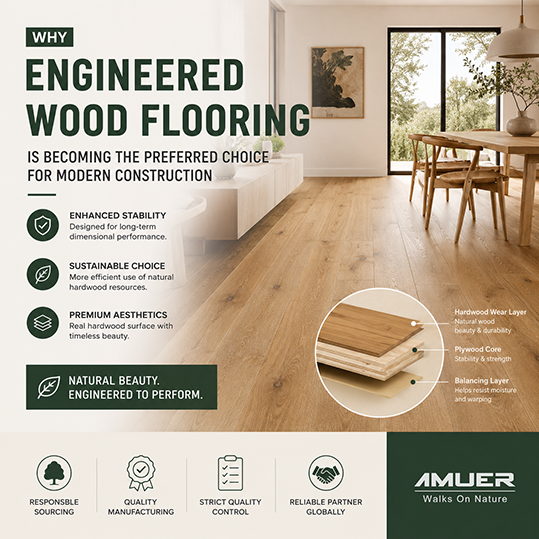
Why Engineered Wood Flooring Is Becoming the Preferred Choice for Modern Construction
Published by AMUER
July 28, 2026
Introduction
Wood flooring has remained one of the most valued interior materials for centuries because of its natural beauty, durability, and ability to create warm living spaces. However, modern construction environments have introduced new challenges, including larger interior spaces, underfloor heating systems, changing humidity conditions, and increasing sustainability requirements. As a result, engineered wood flooring has become an increasingly popular solution among architects, designers, contractors, and flooring distributors worldwide.
Unlike traditional solid hardwood flooring, engineered wood flooring combines a genuine hardwood surface with a carefully designed multi-layer structure. This approach provides improved stability while maintaining the authentic appearance and character of natural timber.
The Evolution of Modern Wood Flooring
Traditional solid wood flooring is valued for its natural characteristics, but wood is also a material that responds to environmental changes. Seasonal humidity fluctuations can cause expansion, contraction, and movement over time. These challenges become more noticeable in regions with significant climate changes or in buildings using modern heating systems.
Engineered wood flooring was developed to address these technical limitations. By combining multiple layers with different grain directions, manufacturers can reduce internal stress and improve dimensional stability. This construction allows wider planks, longer boards, and more flexible installation options while preserving the visual appeal of hardwood.
For commercial buildings, luxury residences, and hospitality projects, this balance between natural appearance and technical performance has made engineered flooring an increasingly preferred choice.
How Engineered Wood Flooring Is Manufactured
The quality of engineered wood flooring begins with raw material selection. Premium products often use carefully selected hardwood species such as European Oak, which is recognized for its durability, attractive grain structure, and suitability for high-end interior applications.
A typical three-layer engineered floor consists of three key components:
►Top Layer: A genuine hardwood wear layer that provides the natural appearance and surface character.
►Middle Layer: A cross-laminated core designed to improve stability and reduce movement.
►Bottom Layer: A balancing layer that helps maintain structural performance.
The cross-layer structure is one of the main advantages of engineered flooring. By placing wood layers in different directions, manufacturers can better control the natural movement of timber caused by moisture changes.
Why Moisture Control Determines Floor Quality
Moisture management is one of the most important factors in flooring manufacturing. Wood naturally absorbs and releases moisture depending on environmental conditions, meaning poor moisture control can create problems after installation.
Professional wood flooring factories carefully monitor moisture content throughout the entire production process, including raw material preparation, pressing, machining, and final inspection. Proper moisture control helps improve bonding performance, reduce internal stress, and maintain long-term dimensional stability.
For international buyers, understanding a manufacturer's quality control process is often more important than simply comparing product prices.
Three Quality Factors Buyers Should Understand
When selecting a flooring supplier, buyers should evaluate several technical factors beyond surface appearance.
Bonding Strength
High-quality engineered flooring requires reliable adhesive performance between each layer. Proper bonding helps prevent delamination and ensures the floor remains stable throughout its service life.
Surface Performance
Different finishes provide different levels of protection and appearance. Natural oil finishes emphasize wood texture and create a matte appearance, while UV lacquer finishes provide stronger surface protection for demanding applications.
Dimensional Stability
A well-designed engineered structure should maintain its shape under changing temperature and humidity conditions, making it suitable for modern buildings and underfloor heating systems.
Why European Oak Flooring Remains Popular
European Oak Flooring continues to be one of the most requested choices in premium flooring markets. Its popularity comes from its distinctive grain patterns, natural color variation, durability, and ability to complement both traditional and contemporary interiors.
Modern finishing techniques, including brushing, smoking, hand-scraping, and natural oil treatment, further enhance oak's natural character while providing designers with more creative possibilities.
How to Choose a Reliable Flooring Supplier
For importers, distributors, and project developers, choosing a reliable flooring supplier requires evaluating the complete manufacturing capability rather than focusing only on price.
・Timber sourcing and certification
・Production capacity and consistency
・Quality inspection procedures
・Core construction technology
・Finishing capability
・Packaging and export experience
A professional flooring supplier should provide consistent quality across different orders and support customers with technical information throughout the purchasing process.
Conclusion
Engineered wood flooring represents the combination of traditional natural materials and modern manufacturing technology. By improving stability, optimizing timber usage, and meeting the requirements of contemporary construction, engineered flooring has become an important solution for global residential and commercial projects.
As sustainability, performance, and design flexibility continue to influence flooring decisions, manufacturers with strong production capabilities and quality control systems will play an increasingly important role in the international flooring market.
About AMUER
AMUER specializes in engineered wood flooring manufacturing, providing three-layer and multi-layer flooring solutions, European oak flooring, herringbone flooring, and customized wood flooring products for international markets. More information about AMUER products and manufacturing capabilities is available at www.amuerflooring.com.
Summary
Engineered wood flooring is becoming a preferred choice for modern construction because it combines natural hardwood aesthetics with improved stability and manufacturing precision. Through advanced multi-layer structures, moisture control, and responsible material usage, engineered flooring provides architects, distributors, and contractors with a reliable solution for contemporary building requirements.
Keywords
Engineered Wood Flooring, European Oak Flooring, Wood Flooring Manufacturer, Flooring Supplier, Sustainable Flooring