5 Questions Every Flooring Buyer Should Ask Before Choosing a Wood Flooring Manufacturer
- Share
- Issue Time
- Aug 5,2026
Summary
Choosing the right wood flooring manufacturer requires evaluating more than price. Buyers should consider timber sourcing, moisture control, quality testing, production consistency, and long-term manufacturing capability. Asking the right questions helps reduce sourcing risks while ensuring reliable product performance and stronger business partnerships in today's competitive flooring market.
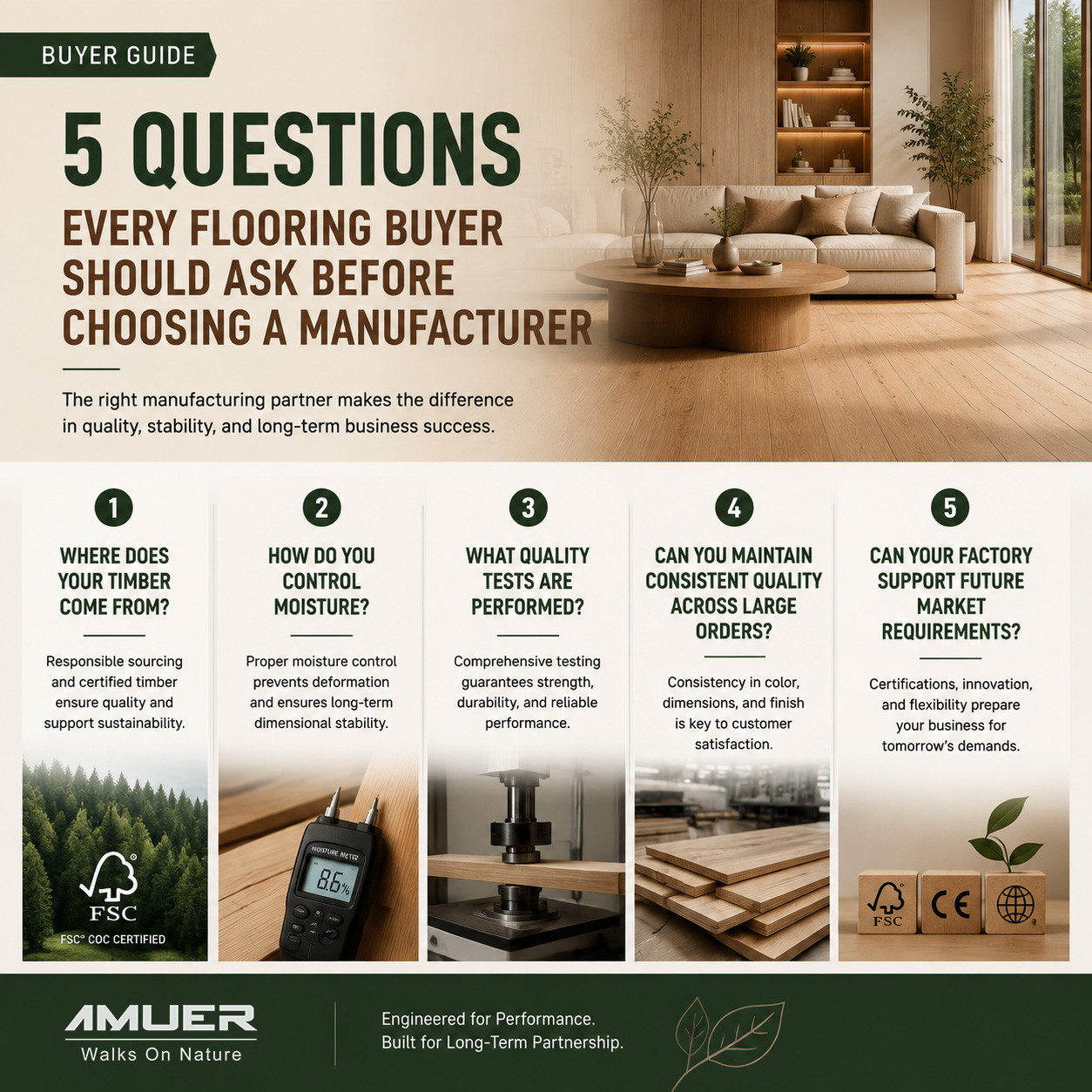
5 Questions Every Flooring Buyer Should Ask Before Choosing a Wood Flooring Manufacturer
Category: Industry Insights & Buyer Guide
Published by AMUER
August 4, 2026
Introduction
Selecting the right wood flooring manufacturer has become more challenging than ever. While price remains an important consideration, professional buyers are increasingly evaluating suppliers based on manufacturing capability, product consistency, sustainability, and long-term reliability. As global construction standards continue to evolve and customers demand higher-quality products, choosing the right manufacturing partner can directly influence project success, customer satisfaction, and brand reputation.
Whether you are a flooring importer, distributor, wholesaler, contractor, or private-label brand, asking the right questions before placing an order can help reduce risk and build stronger long-term partnerships. Here are five essential questions every flooring buyer should ask before choosing a wood flooring manufacturer.
Why This Matters
Today's flooring market is no longer driven solely by competitive pricing. Buyers are paying closer attention to supply chain transparency, responsible timber sourcing, manufacturing quality, and compliance with international standards. Large commercial projects and premium residential developments increasingly require suppliers to provide consistent products supported by documented quality control and environmental certifications.
A reliable manufacturing partner should be able to deliver more than attractive samples. They should demonstrate stable production capacity, technical expertise, and the ability to maintain consistent quality across every shipment.
Question 1: Where Does Your Timber Come From?
The quality of engineered wood flooring begins with the raw material. Ask your supplier where the timber is sourced, whether it comes from responsibly managed forests, and if certification such as FSC or PEFC is available when required.
European Oak remains one of the most popular hardwood species because of its durability, attractive grain pattern, and versatility across different interior styles. However, even premium wood species require proper grading, drying, and processing to achieve consistent flooring performance.
Question 2: How Do You Control Moisture Throughout Production?
Wood naturally responds to changes in humidity, making moisture control one of the most critical manufacturing processes. Poor moisture management may increase the risk of dimensional movement, bonding issues, or installation problems after the flooring reaches its destination.
Professional manufacturers monitor moisture content from raw material preparation through pressing, machining, and final inspection. Consistent moisture control contributes to better dimensional stability and long-term product performance in different climate conditions.
Question 3: What Quality Tests Are Performed Before Shipment?
Quality inspection should go beyond visual appearance. Buyers should understand how products are tested before shipment and whether the factory performs routine inspections on bonding strength, dimensional stability, surface quality, and machining accuracy.
Manufacturers with comprehensive quality control procedures are generally better equipped to deliver consistent products across multiple production batches, helping distributors reduce warranty claims and installation issues.
Question 4: Can You Maintain Consistent Quality Across Large Orders?
A flooring sample may look excellent, but large-scale production is where a manufacturer's true capability is demonstrated. Professional buyers should ask how the factory ensures consistency across different production batches, especially for large commercial or distribution orders.
Consistency includes more than color matching. It involves maintaining uniform dimensions, moisture content, surface finish, machining precision, and packaging standards throughout the production process. Modern wood flooring factories achieve this through standardized operating procedures, calibrated equipment, digital quality inspections, and experienced production teams.
Reliable consistency helps distributors reduce installation issues, minimize customer complaints, and build long-term confidence in their product offerings.
Question 5: Can Your Factory Support Future Market Requirements?
The flooring industry continues to evolve as sustainability regulations, customer expectations, and design trends change. Buyers should evaluate whether a manufacturer is prepared to meet future requirements rather than only current specifications.
Important considerations include support for FSC-certified materials, compliance with environmental regulations, customized product development, flexible manufacturing capabilities, and experience supplying international markets. A manufacturer that continuously invests in technology and quality management is often better positioned to support long-term business growth.
Expert Insight
One of the biggest misconceptions in international sourcing is that larger factories automatically produce better flooring. In reality, manufacturing excellence depends on process control rather than factory size alone.
Successful wood flooring manufacturers typically focus on four core areas: responsible timber selection, precise moisture management, stable pressing technology, and rigorous quality inspection. These processes work together to produce flooring that performs consistently throughout transportation, installation, and years of daily use.
For buyers, understanding how a manufacturer controls these processes often provides a more accurate picture of product quality than comparing prices alone.
Key Takeaways
- Evaluate timber sourcing before comparing product specifications.
- Ask how moisture content is monitored throughout manufacturing.
- Understand the factory's quality testing and inspection procedures.
- Choose manufacturers capable of maintaining consistent production across every order.
- Look for partners that invest in sustainability, technology, and long-term manufacturing excellence.
Conclusion
Selecting a wood flooring manufacturer is no longer simply about finding the lowest price. It is about choosing a partner that can consistently deliver reliable quality, technical expertise, and responsible manufacturing practices.
By asking these five questions before placing an order, flooring buyers can better evaluate suppliers, reduce sourcing risks, and build stronger long-term partnerships. As the global flooring industry continues to prioritize sustainability, consistency, and product performance, informed purchasing decisions will become an increasingly important competitive advantage.
About AMUER
AMUER is a manufacturer specializing in engineered wood flooring for international distributors, wholesalers, contractors, architects, and flooring brands. Its product portfolio includes three-layer and multi-layer engineered flooring, European oak flooring, herringbone flooring, chevron flooring, and customized flooring solutions manufactured for residential and commercial applications worldwide.
Learn more about AMUER's manufacturing capabilities and engineered wood flooring solutions at: https://www.amuerflooring.com/
Summary
Choosing the right wood flooring manufacturer requires evaluating more than price. Buyers should consider timber sourcing, moisture control, quality testing, production consistency, and long-term manufacturing capability. Asking the right questions helps reduce sourcing risks while ensuring reliable product performance and stronger business partnerships in today's competitive flooring market.
Keywords
Wood Flooring Manufacturer, Engineered Wood Flooring, European Oak Flooring, Flooring Supplier, Sustainable Flooring