Engineered vs Solid Hardwood Flooring: B2B Buyer's Guide
- Share
- publisher
- Amuer
- Issue Time
- Sep 7,2026
Summary
Engineered vs solid hardwood flooring: construction, stability, installation, cost and best uses compared — a practical guide for project buyers.
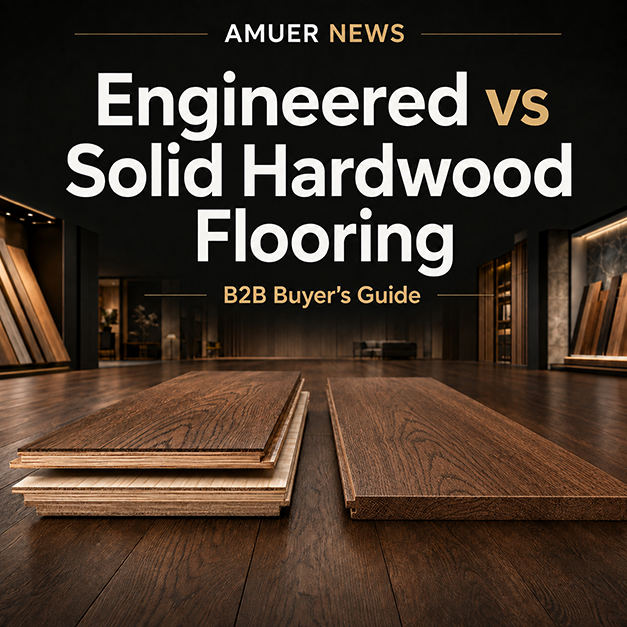
Engineered vs Solid Hardwood Flooring: What B2B Buyers Need to Know
"Engineered or solid?" is the first question every flooring buyer asks — and the answer decides everything downstream: what the floor costs, where it can be installed, whether it works with underfloor heating, and how it behaves after the container arrives. For distributors and project buyers, the stakes are higher than for a homeowner: a wrong choice repeated across a hotel or an apartment complex is an expensive mistake. This guide compares the two constructions honestly, shows when each one wins, and explains the construction details that decide real quality — the part most comparison articles skip.
What Is Solid Hardwood Flooring?
Solid hardwood is exactly what the name says: one solid piece of wood from top to bottom, typically 18–20 mm thick. The plank is milled from a single board, so its entire thickness is the same species. It has been the traditional floor for centuries, and it can be sanded and refinished many times over its life because there is no thin top layer to sand through.
That same solidity is also its limitation. Wood expands and contracts with changes in humidity, and a solid plank — being wood all the way through — moves more across its width. Solid flooring is normally nailed or stapled to a wooden subfloor, needs acclimatization, and is generally not recommended over concrete slabs, over radiant underfloor heating, or in spaces with wide humidity swings.
What Is Engineered Hardwood Flooring?
Engineered hardwood is built like a sandwich: a real hardwood wear layer on top, bonded to a multi-layer core of wood — typically cross-ply plywood or HDF — with each layer's grain running in an alternating direction. That cross-ply structure is the whole idea: the layers lock against each other, so the plank expands and contracts far less across its width than a solid board of the same species.
The top wear layer is genuine hardwood — the same oak, walnut or ash you would see on solid flooring — which is why engineered floors still look, feel and refinish like real wood. What changes is the core, and the core is what makes engineered flooring dimensionally stable enough for wide planks, long planks, concrete subfloors and heating systems.
Engineered vs Solid: The Quick Comparison
| Comparison Point | Engineered Hardwood | Solid Hardwood |
|---|---|---|
| Construction | Hardwood wear layer + cross-ply wood core | One solid piece of wood |
| Dimensional stability | High — cross-ply layers limit movement | Lower — expands and contracts with humidity |
| Over concrete slabs | Yes (glue or floating) | Requires plywood subfloor preparation |
| Underfloor heating | Compatible with most systems | Generally not recommended |
| Wide / long planks | Stable in large formats | Limited width before movement becomes an issue |
| Installation | Floating, glue or staple; faster on site | Nail/staple, slower, needs acclimatization |
| Refinishing life | 1–3 sanding cycles (wear layer dependent) | Many sanding cycles over its life |
| Typical price level | Broad range; premium engineered can exceed solid | Depends on species, grade and thickness |
| Best settings | Hotels, apartments, offices, heating zones, large formats | Traditional homes, nail-down wood subfloors, long-life refinish plans |
The headline: engineered flooring wins on stability and installation flexibility; solid flooring wins on maximum refinishing depth. For most modern commercial and residential projects — especially over concrete — engineered is the practical choice.
When Engineered Hardwood Is the Right Choice
If any of these apply to your project, engineered flooring is the lower-risk answer:
- The building has concrete slabs. Hotels, apartments and offices are almost always built on concrete. Engineered floors glue or float directly over it; solid floors need a wooden subfloor built first.
- Underfloor heating is involved. Radiant heating warms a floor from below and asks it to stay flat. Engineered's cross-ply construction handles the temperature cycling far better than solid wood, which is why heating manufacturers and flooring suppliers rarely recommend solid.
- The design calls for wide or long planks. Wide plank and long plank are engineered products by necessity — a solid board wide enough for the fashion would move too much. If your client wants the clean, modern look of wide oak, engineered is how it is built.
- Speed and site conditions matter. Floating engineered floors install fast with click systems, no acclimatization delays are as long, and rooms can be walked on almost immediately — an advantage in renovation projects and phased construction.
- Humidity swings are part of the climate. Coastal, tropical or tightly sealed modern buildings all create moisture conditions where stability pays for itself.
When Solid Hardwood Still Makes Sense
Solid is not obsolete — it is simply specific. Consider it when:
- The subfloor is wood (e.g. timber-frame construction or a raised wooden floor) where nailing down is natural;
- Maximum refinishing life is the priority — a solid plank can be sanded many more times, which suits owners who expect decades of use and periodic restorations;
- Traditional construction methods are specified by architects or heritage requirements;
- The project is in a stable indoor climate without heating systems and without large humidity variation.
For a buyer deciding between the two, the honest rule is: choose solid only when the project genuinely needs its deep refinishing capacity and the subfloor allows it. In every other case, engineered delivers the same visible wood with fewer installation risks.
Quality Is Decided by Construction, Not by the Engineered/Solid Label
This is the part that protects your project. Within either category, quality varies enormously — and it is determined by specific construction details you can write into a specification:
- Wear layer thickness. A thicker sawn veneer (e.g. 3–4 mm and up) allows more sanding cycles and looks more like solid wood; thin rotary-cut veneers are cheaper but limit refinishing. This is one of the largest price drivers in engineered flooring.
- Core quality. A stable, well-bonded multi-layer core resists cupping and movement. Ask what the core is made of and how many plies it has.
- Adhesive and pressing quality. Delamination — layers separating — is the classic engineered failure, caused by poor glue and pressing. A factory with controlled layup and pressing lines, verified over decades of production, is the reliable answer.
- Surface finish. The lacquer or oil system determines scratch, stain and wear resistance. Quality UV-cured lacquer or oils from a controlled line outperform cheap finishes quickly.
- Moisture control at the factory. The moisture content of the planks when packed affects how the floor behaves in your climate. Ask for the factory's moisture standard and check it at inspection.
And remember the distinction from our grades guide: grade describes how a plank looks, construction describes how it performs. A low-grade engineered floor can be a very good product; a high-grade floor with a poor core is still a bad floor. When you compare two suppliers, compare construction and certifications — CE, CARB Phase 2, FSC and ISO 9001 are useful filters — before you compare appearance. A manufacturer like AMUER applies the same engineered construction across its full A–F appearance range, so buyers choose the look they need without gambling on durability.
What to Write Into Your Purchase Order
| Field | Example Entry |
|---|---|
| Construction type | Engineered, multi-layer cross-ply core, 14 mm total thickness |
| Wear layer | Sawn oak veneer, 3 mm minimum after finishing |
| Grade | Grade B per the factory's written A–F grading checklist |
| Format & profile | 1900 × 190 × 14 mm, long plank, 5G click system |
| Finish | UV matte lacquer, brushed surface, tone matched to retained sample |
| Installation method | Floating over underfloor heating, confirmed compatible by the supplier |
| Certifications | CE, CARB Phase 2, FSC chain of custody, ISO 9001 |
With this level of detail on the order, the sample, the inspection and the delivered goods all reference the same document — and disputes become rare.
Frequently Asked Questions
Q1: Which is better — engineered or solid hardwood flooring?
There is no universal winner; there is the right product for the project. Engineered wins for concrete subfloors, underfloor heating, wide/long formats and faster installation. Solid wins where maximum refinishing depth matters and the subfloor is wood. For most hotels, apartments and offices, engineered is the lower-risk choice.
Q2: Is engineered hardwood flooring real wood?
Yes. The visible surface is genuine hardwood — the same oak, walnut or ash as solid flooring. The difference is underneath: a cross-ply engineered core replaces the lower half of the solid board to improve stability. It looks, feels and finishes like real wood because the top layer is real wood.
Q3: Can engineered wood flooring be used with underfloor heating?
Yes — this is one of its main advantages. The cross-ply construction handles temperature cycling far better than solid wood. Always confirm the specific product's compatibility and the maximum surface temperature with the supplier before ordering.
Q4: Can engineered hardwood flooring be refinished?
Yes, up to a limit set by the wear layer. A thick sawn veneer (3 mm and above) can typically be sanded and refinished several times over decades of use. Thin wear layers allow fewer cycles — check the wear layer thickness before buying if long-term refinishing matters to your client.
Q5: Is engineered or solid hardwood more expensive?
It depends on the specification. Quality engineered flooring with a thick wear layer and a stable core is comparable to — and can exceed — entry-level solid. The honest comparison is not "engineered vs solid" but construction quality and grade within each category.
Q6: Can distributors order both engineered and solid from one factory?
Many projects mix requirements, and working with one certified manufacturer simplifies QC, documentation and batch consistency. AMUER produces engineered hardwood across long plank, wide plank, herringbone, chevron and parquet formats, with OEM/ODM support and dual-factory production in Dalian and Serbia.
See the Construction Difference for Yourself
Explore the AMUER engineered hardwood collection — long plank, wide plank, herringbone, chevron and parquet — and compare how each product is built, grade by grade.
Explore the Engineered Hardwood Collection →Request samples with the full construction specification. We will send physical sample boards — including a cross-section so you can see the wear layer and core — plus the written grade chart for your project team.
Request Samples & Specification →