AMUER Natural Wood Wall & Ceiling Cladding — Bring the Floor to Every Surface
Review
Description
AMUER Natural Wood Wall & Ceiling Cladding — Bring the Floor to Every Surface
Product Overview
A reduced material mix is the key to high-quality design concepts. When the same natural wood that covers your floor is used as wall or ceiling cladding, the result is a space of extraordinary coherence — warmer, quieter, and unmistakably intentional.
AMUER wall and ceiling cladding panels are produced directly from the same floor boards as the AMUER flooring range. Same species, same surface treatment, same timber batch — not an approximation, but the same material. Additional panels can be ordered alongside any floor order; matching fixings are available at any time.
Installation is straightforward using a cushioned wood construction with concealed fixing via tongue and groove — invisible once installed, dimensionally stable, and allowing natural seasonal movement.

Technical Specifications
Specification | Detail | ||
Material | Natural solid wood and semi-solid wood — same specification as AMUER floor board range | ||
Available Species | European Oak, Walnut, Ash, Larch, Douglas Fir — all AMUER floor species | ||
Panel Dimensions | Width and length derived from floor board formats; custom sizing available on request | ||
Thickness | Matched to floor board thickness — typically 11–21 mm depending on species and format | ||
Surface Treatments | Natural oil, hardwax oil, white oil, gray oil, brushed, smoked/fumed, thermo-treated | ||
Joint Profiles | Tight joint / Shadow gap (3–10 mm) / Tongue-and-groove / Beveled V-groove | ||
Fixing Methods | Secret nail/clip (recommended) / Face fixing / Adhesive / Magnetic system | ||
Moisture Content | 6–9% at dispatch — kiln-dried, equilibrated for interior conditions | ||
VOC Emissions | No VOC, no formaldehyde — natural oil and hardwax oil finishes | ||
Fire Treatment | Class B fire-retardant treatment available on request for commercial projects | ||
Certifications | FSC / PEFC certified timber available on request | ||
Lead Time | Produced with floor order — typically 3–6 weeks | ||
Why Natural Wood on Walls and Ceilings
A Reduced Material Mix
The most compelling interiors use fewer materials, better chosen. When the same wood species and finish runs from floor to wall — or floor to ceiling — the boundaries between surfaces dissolve. The room feels cohesive, enveloping, and resolved. Wood is used as an identity-establishing material: the repetition of the coordinated material as a stylistic device ensures comfort and elevated aesthetics in every room.
Indoor Climate & Air Quality
Natural wood is hygroscopic: it absorbs and releases moisture from the surrounding air, acting as a passive humidity regulator — a powerless air conditioner of sorts. Wood-clad rooms maintain more stable relative humidity, improving comfort for all occupants and offering particular benefit for allergy sufferers. The larger the wood surface area (floor + walls + ceiling), the more pronounced this buffering effect.
AMUER cladding panels are finished with natural oil or hardwax oil — free from formaldehyde, free from solvent-based lacquers, and certified for use in the most demanding indoor air quality environments including children's rooms and healthcare facilities. Wood also filters pollutants from the air, with a measurable positive effect on health and well-being.
Biophilic Well-Being
International studies show that people spend around 90% of their day indoors. Natural wood on walls and ceilings has been shown to reduce stress, lower heart rate, and increase perceived comfort — an evidence-based contribution to healthier living and working environments.

Applications
| Application | Effect | Best For | ||||
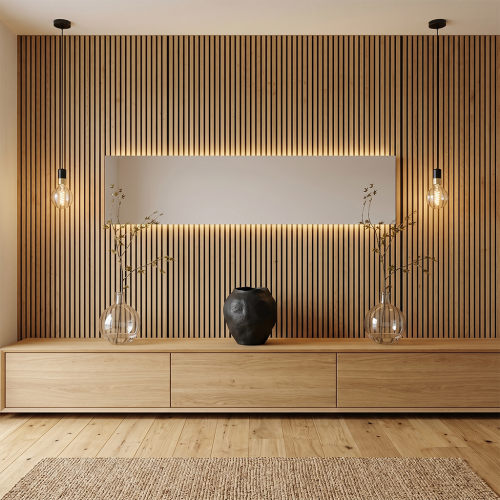
| Feature Wall | Immediate focal point; warmth and texture without overwhelming the room | Behind a bed, sofa, or entrance wall; any room requiring a statement surface | ||||
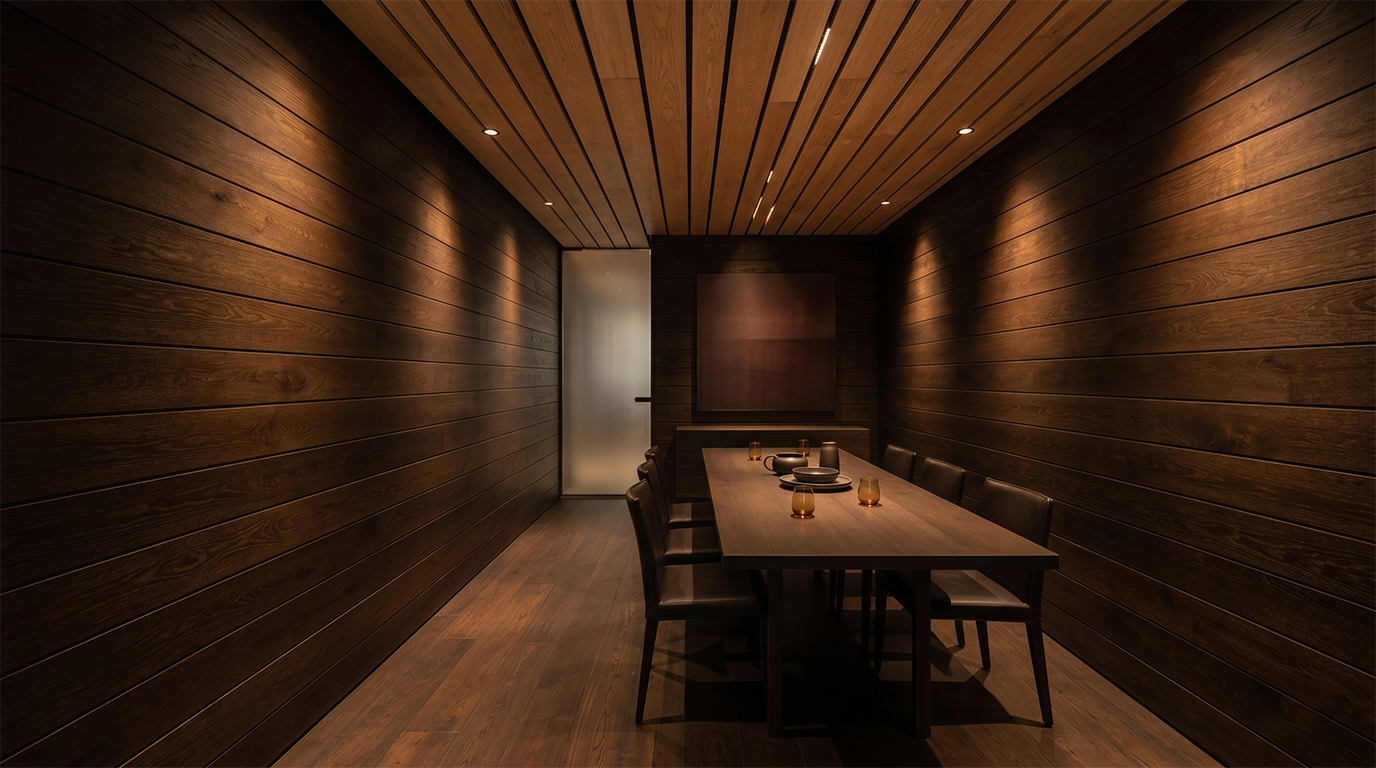
| Complete Room Cladding | Enveloping, immersive atmosphere; extraordinary warmth and focus | Study, cabin, home office, meditation room, private dining, intimate hospitality | ||||
| Ceiling Cladding | Architectural gesture; acoustic softening; visual depth overhead | Rooms with exposed beams, flat concrete ceilings, or low natural light | ||||
Floor-to-Ceiling | Total material unity; the room feels sculpted from one material | Premium residential, boutique hotel, luxury retail — maximum impact | ||||
Corridor & Hallway | Transforms transitional spaces; rhythm and depth along the run | Long corridors, entrance halls, stairwells where warmth and material flow matter | ||||
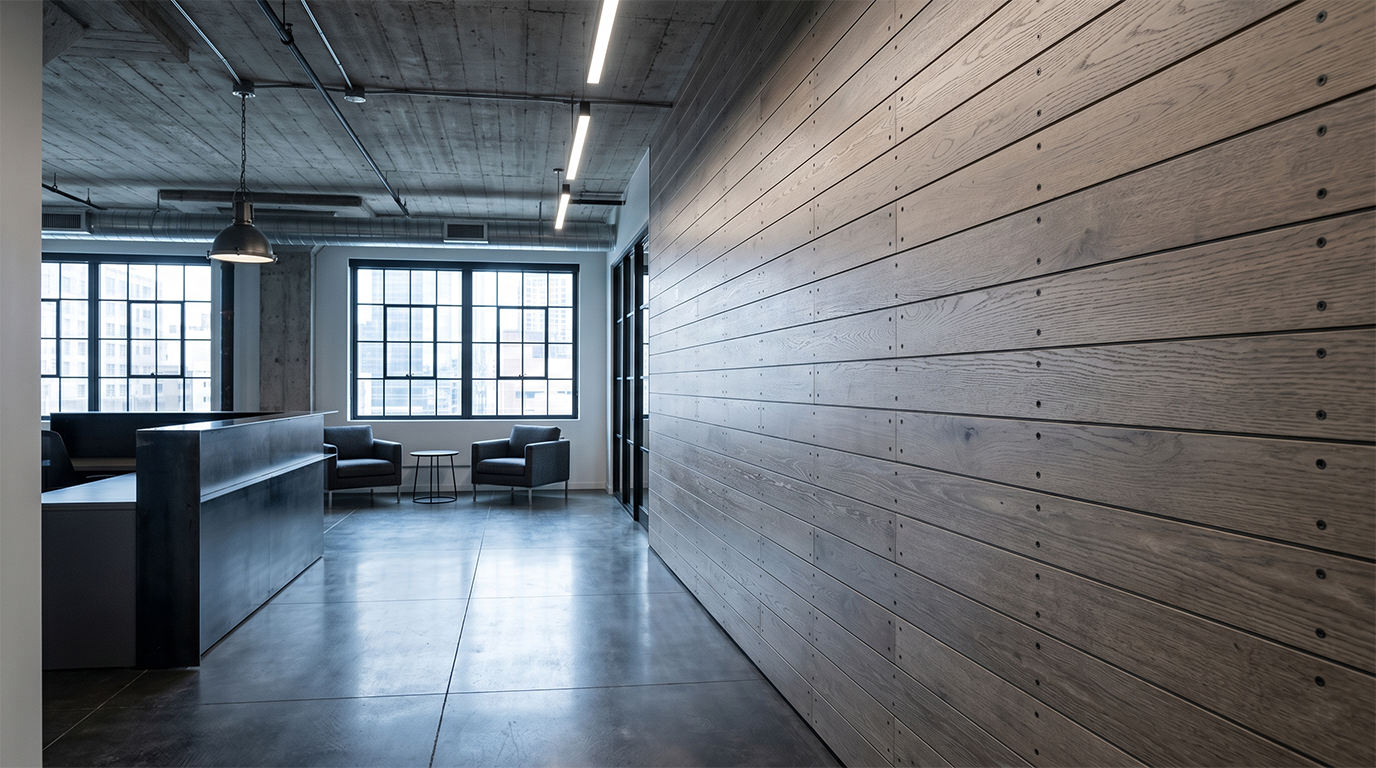
Curved Wall Cladding | Bold design statement; visually enhances complex floor plans | Offices, restaurants, private homes — using specially shaped planks | ||||
AMUER cladding panels are suitable for walls, ceilings, and complete room enclosures — from a single feature surface to a full floor-to-ceiling treatment. Specific areas can be accented using the same material as the adjacent wood flooring.
Joint Profile Options
The joint detail between cladding panels is one of the most significant design decisions in a wall cladding specification — it defines the visual rhythm and character of the entire surface.
| Joint Type | Visual Effect | Design Context | ||||
| Tight Joint | Continuous, seamless wood surface — floor-like | Narrow plank; maximizes the sense of a single material surface | ||||
| Shadow Gap (3–10 mm) | Deliberate gap creates rhythmic shadow lines between panels | Most popular for premium residential and hospitality; adds depth and architectural resolution | ||||
| Tongue & Groove | Mechanical joint; most dimensionally stable | Wide panels; environments with humidity variation; concealed fixing | ||||
Beveled / V-Groove | Factory chamfer creates a V-shadow line at each joint | Classic detail; suits both traditional and contemporary interiors | ||||
Wood Species
| Species | Character | Typical Use | |||||
| European Oak | Warm cream to deep amber; dense consistent grain; most versatile | Any interior style; white oil, natural oil, brushed, smoked — all work on large wall surfaces | |||||
| Walnut | Dark chocolate, fine linear grain; immediately luxurious | Hotel bedrooms, private dining, home offices, bar environments — high-end feature walls | |||||
| Ash | Pale blonde, athletic grain; bright and linear | Scandinavian and New Nordic — light-maximizing walls and ceilings in rooms with limited daylight | |||||
Larch | Warm reddish-orange, visible knots; rustic authenticity | Alpine lodges, rural retreats, spa environments — ceiling and full-room applications | |||||
Douglas Fir | Light tan softwood; relaxed and natural tone | Open-plan residential, casual interiors — adds warmth without formality | |||||

Surface Finishes
Every AMUER wall and ceiling cladding panel receives the same surface treatment as the corresponding floor product — the foundation of true cross-surface color and texture matching.
•Natural Oil — Penetrating matte finish; warm and authentic; the most popular choice for residential wall cladding; locally repairable
•Hardwax Oil — Penetrating oil + thin wax for enhanced surface resilience; suitable for high-contact wall areas in corridors and hospitality; wide tinted color range
•White Oil — Bleached pale tone; creates light, serene interiors with a Nordic character; particularly effective in rooms with limited natural light
•Gray / Silver Oil — Cool, sophisticated tone; coordinates with concrete floors, polished plaster, and metal fixtures in industrial-modern schemes
•Brushed — Wire-brushed open grain; tactile depth; catches light differently at different times of day — a dynamic, living wall surface; works particularly well with raking or directional lighting
•Smoked / Fumed Oak — Deep brown-gray via heat treatment; dramatic, high-contrast interiors; pairs with smoked oak floors for total material intensity
•Thermo-Treated — Heat-treated for enhanced dimensional stability; improved moisture resistance; suitable near kitchens and bathrooms

Installation Guide
1 — Acclimatize
Allow cladding panels to acclimatize in the installation environment for a minimum of 48–72 hours before fixing. Store flat or standing upright on a clean dry surface with air circulation on all sides. This step is critical — panels installed without adequate acclimatization may move, gap, or cup after fixing.
2 — Substrate Preparation
•All surfaces must be structurally sound, dry, and free of loose material
•Flat to within ±3 mm over a 2-meter span
•For direct adhesive application: clean, primed, moisture-free (max. 2% CM for masonry)
•For battened systems (recommended): fix timber or metal battens to structural substrate at centres appropriate for the panel format chosen
3 — Fixing Methods
•Secret nail / clip fixing (recommended) — Fixed through the tongue into the batten. Invisible once installed; allows controlled seasonal movement; no surface fixings visible
•Face fixing — Screws or nails countersunk and filled. Suitable for rustic or industrial aesthetics where fixings are part of the visual character
•Adhesive fixing — Flexible MS polymer adhesive in ribbons for smooth masonry or concrete without battens. Ensure full perimeter adhesion
•Magnetic fixing — For removable panel systems where access behind the cladding is required (hotel rooms, serviced apartments with concealed services)
4 — Corners & Edge Details
•Internal corners — Mitered (most seamless) or butt-jointed with a timber cover bead
•External corners — Mitered; or shadow gap detail allowing panels to return around the corner with a deliberate open joint
•Metal inserts — Aluminum or stainless steel profile inserts for an industrial-modern corner detail
Care & Maintenance
•Regular cleaning — Dry or slightly damp microfiber cloth. For shadow gaps, use a soft brush vacuum attachment — avoid water-saturated cloths near joints
•Annual re-oiling — Apply AMUER Maintenance Oil or compatible hardwax oil refresher once a year, working in the direction of grain. Restores protection and natural luster
•Spot repair — Lightly sand affected area (fine sandpaper, grain direction) and apply maintenance oil. No need to refinish the entire wall — one of the key advantages of oil-finished wood over painted surfaces
•Humidity management — Maintain 40–60% RH year-round. Consistent indoor climate protects wider panel formats from movement over the long term
•Avoid prolonged moisture — Not suitable for shower enclosures or direct water contact. For areas with higher moisture, specify thermo-treated panels and ensure adequate ventilation
FAQ
Q: Can AMUER wall cladding be genuinely matched to my floor?
Yes — this is the fundamental premise of AMUER wall and ceiling cladding. The panels are produced directly from the same floor board products, using the same timber batches and finishing processes. When floor and wall cladding are ordered together, the color, grain, and surface texture match with a precision that is simply not possible with products manufactured separately.
Q: Is wood wall cladding suitable for use in kitchens?
Yes, with appropriate specification. AMUER cladding panels finished with hardwax oil or thermo-treated panels are suitable for kitchen walls where they will be exposed to ambient cooking moisture and occasional splashing. They should not be used directly behind hob cooking surfaces or in areas subject to continuous water contact. A heat-resistant splashback should be specified behind cooking zones.
Q: Can AMUER cladding be used in bathrooms?
AMUER natural wood cladding is suitable for bathroom walls that are not directly wetted — for example, the wall behind a vanity unit, the wall opposite a shower, or a feature wall in a spa-style bathroom. Thermo-treated panels offer improved moisture resistance and dimensional stability for bathroom applications. Direct shower enclosures require a waterproof surface; wood is not appropriate for this use.
Q: Does wood wall cladding improve acoustics?
Yes. Natural wood wall and ceiling cladding has acoustic absorption properties that help reduce reverberation in hard-surfaced rooms. Panel formats with shadow gaps and open joints, and installations that incorporate an air gap behind the panels (battened systems), perform particularly well acoustically. AMUER cladding is regularly specified in home cinemas, recording studios, hotel rooms, and restaurant interiors where acoustic quality is important.
Q: Can AMUER cladding panels be used for ceiling applications?
Yes. AMUER panels are suitable for ceiling cladding when fixed to an appropriate substrate — typically a counter-batten system fixed to the structural ceiling. Ceiling applications require fixing systems with adequate load-bearing capacity, and panels should be acclimatized to the room conditions before installation. A structural engineer should be consulted for large-area ceiling installations.
Q: What is the minimum order quantity?
AMUER wall and ceiling cladding is produced to order — panels are manufactured as part of a flooring order to ensure timber batch consistency. Minimum order quantities apply per species and format; contact the AMUER team with your project dimensions for a specific quotation.
Q: Is AMUER cladding available with fire-retardant treatment for commercial applications?
Yes. For commercial, public, and hospitality projects requiring compliance with Class B or Class C fire performance standards, AMUER can supply panels with a certified fire-retardant treatment. This treatment does not significantly alter the appearance or surface finish of the wood. Certification documentation is available on request.
Q: How do I calculate how many panels I need?
Calculate the total wall or ceiling surface area to be clad in square meters. Add a cutting waste allowance of 10–15% for standard rooms (more for rooms with many windows, doors, or complex geometry). AMUER's technical team will assist with a detailed quantity take-off for your project based on the panel format and joint specification you choose.
How to Order
•Order cladding panels together with your floor for guaranteed same-batch material consistency
•Specify wood species, surface finish, panel format, and joint profile
•Provide wall and ceiling surface areas — the AMUER team will calculate quantities and cutting waste
•Request a sample pack to compare cladding and floor finishes in your space before specifying
•For commercial projects: discuss fire treatment, acoustic data, and sustainability certification requirements
•If you already have an AMUER floor, request a matched cladding sample from the same species and finish
Design Inspiration